Friday, November 27, 2009

Happy Thanksgiving!

Happy Thanksgiving everyone! As I'm sure you already know, I am very thankful for all of you, my friends & family (and stalkers), and I just want to remind you how much I appreciate your love and support. To show you my appreciation, I have slaved over a computer to upload and caption some photos :). I hope you all have a wonderful day!

Chowing down on sugarcane and tea with my hostbrother, Mutaka, and some other kids from the village.

Everything needed to make tea...something I do often in my village :). I'm going to explain the process of how tea is made here, not because I want to bore you, but because it's such an important part of the culture and the everyday lives of Malians. The actual process of making tea is rather lengthy (takes at least an hour), but Malians love to sit around and chat over their 'three cups of tea'. To give you an idea, most of the people in my village have no money, they just farm their fields and then eat the crops. But, whenever there is money to be had, it is often spent on buying tea and sugar.

Making tea: The blue teapot sits on the charcoal stove boiling the water & loose tea. When the first pot of tea is finished brewing (3 pots are made with one pack of loose tea), it's poured into the red teapot. The blue pot is then refilled with water (from the tin cup on the left) and put back on the stove. Then sugar is added to the red teapot and the tea is poured over and over (about 10 times?), back and forth between the teapot and the little clear tea glass (sitting to the right of the red pot). This repetition of pouring is an important part of the process in that it not only mixes in the sugar, but it also creates a foam at the top of the tea (yes, like a pint of Guinness). When I first came to Mali, I was unable to create the foam, but with lots of practice, my tea making abilities have come a long way :). Once the foam is made and the tea is sufficiently mixed, the red pot is then put on the stove to reheat the tea one last time before serving to your company. When serving, the tea glass is normally filled about halfway (w/ more or less depending on how many people will be drinking), and is first served to the eldest person of the group. Once that person finishes, the tea glass is returned to the person pouring, the glass is refilled, and then served to the next oldest...and so on. In my town, only one glass is used (some people use 2), so everyone drinks from the same glass, one person/cup of tea at a time.

People in my community burning garbage behind my house and in front of the big tree. There is very little trash because people aren't really buying many packaged goods besides tea. The kid standing in front of the fire was just playing around and I thought it made a cool picture :).

Transporting furniture the 50km (31 miles) from my banking town to Gloria's village (Gloria is another volunteer located about 2 miles from my site). Then I used a donkey and cart to get things the rest of the way to my site. Unfortunately, the roads (and the driver) are so bad that every single piece of wooden furniture on the roof was broken by the time we got to Gloria's village!

These are the beds Gloria and I had made up by a carpenter in a town about 7 miles away. You guessed it, donkey delivery.

This guy, Kalidou, was selected by my village and assigned by Peace Corps to be my homologue/village counterpart/go-to guy. I later found out that he doesn't even live in my village, and I only see him every few weeks. Here he came to visit, and brought me a chicken and pasta as a gift! I brought the live chicken and pasta to my hostmother, and we ate it for lunch :).
At my bank there are military personnel who sit outside and 'protect' it (aka...play checkers and cards all day long). I got to talking about music with one of the guys and before I knew it he brought me into a little house next to the bank to have a little jam session. He sent one of the younger military guys to go get me a drum (a bucket, ha ha), and we sat and played for a while. Another normal day in Mali, ha ha.

Me and the postman, Dabo, at the Dioila post office. Unfortunately, these packages are not all mine, but I was picking them up for myself and other volunteers...and it took me a few trips back and forth to transport them all!
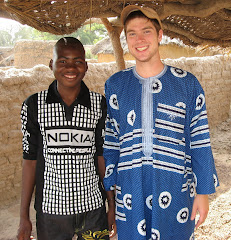
My hostbrother, Mutaka, and I out in the rice fields hanging out under a tree for some shade. Ok, I'll admit, I couldn't help but to climb it, it was a great climbing tree!
Women in my village pulling peanuts off of the roots.

Me and dinner :). Yes, seriously. One of the villagers killed this big lizard out in the fields, and it was later served for dinner. It was pretty good actually, but the skin was kind of tough, ha ha. I've also eaten rabbit...and rat :). The rat was caught in a trap set in the fields, and was probably almost twice the size of this lizard, no joke. It was by far the biggest rat I've ever seen...and he was delicious :).

This picture is taken from the top of hill/mountain which I have to hike up in order to "maybe" get cell reception. If there are clouds in the sky, if it's during the heat of mid-day, or if there's little leprechaun's hanging out in the trees, I won't get service. So, if I need to make a phone call or check voicemail, I make the 30 minute trek from my site to this spot, and more often then not, I still can't get service, ha ha :).

Myself and some Malians at "The Spot" on top of the mountain. Unfortunately, at this moment...none of us could get any reception, ha ha. But, on the occasion that I do get it, the only way I can keep the call connected is if I extend the phone above my head as far as I can, and put the phone on loudspeaker to hear the voicemail or talk to someone. Eventually, all the blood runs out of my arm, and I have to end the call :). What's that? You can lay in your bed in your house and get reception? Must be nice :).

Out in the fields picking cotton with some kids from my village.

Ok, so we WERE picking cotton, until I started joking around and we made ourselves cotton beards, mustaches, and hair, ha ha. For those of you that don't know (I didn't at first), cotton is picked off the plant practically in the form of cotton balls...and it's pretty fun to pick, until you get stabbed by the thorns and have to go digging them out of your finger with a knife :).

My new window!!! Ok, so in my mud house there are two rooms. In the first room is my front door and then one window on the opposite wall. In the "inner" room, there was only one window, so there was hardly any air circulation, causing that room to be very hot and not very well lit (remember my life operates on sunlight...and flashlight). So, as seen above, I had another window installed on the opposite wall of the inner room, and now I get a breeze! Worth every penny (two masons for the day cost $3).

In addition to having the window installed, I am having the masons plaster my mud walls with concrete. I have a serious termite problem (one that caused the termites to eat my already broken furniture!), and plastering the walls not only makes things much cleaner inside, it will also potentially stop the thousands of termites from boring through my walls and attacking me in the middle of the night! Well, the termites don't attack me, but their termite "mounds" fall off the walls and the ceiling while I'm sleeping causing me to get showered by dirt bombs :).

Nightlife in Socourani (my village). Some of the girls made some water drums and asked me to join them on the djembe. Before we knew it, the whole village was out dancing and singing around us in a circle until about midnight (not just the kids, the elders too...just the women though). The water drums are made by flipping big half-shell gourds upside down into buckets of water, and are played by hitting them with a smaller gourds. The big one on the left makes a deep bass drum sound and the smaller one on the right is a bit higher pitched.


Here are some of the women dancing and singing as we play. This picture should also give you a good idea of the types of bright fabrics typically worn by Malian women.

Speaking of fabrics, here is the newest Malian outfit I got made up for the upcoming Muslim holiday, Tabaski. Tabaski is Mali's biggest holiday...I guess it could be compared to Christmas back in the States, so it's a pretty big deal, and loads of people buy new fabrics and have clothes made. Before this, I only had that one silly outfit (the bowling outfit from swear-in), but now I have two :).

Ok, that's a wrap with the pictures for now, I hope you enjoyed them. I just want to make a quick closing remark, because I have a feeling some of you are wondering what the heck I've been doing over here for the past two months, ha ha :). From my pictures, you can probably tell that I've been spending quite a bit of time getting my house set up, getting furniture made and transporting it, adding windows, plastering my walls, etc.

In addition to house work, I've also spent time going out into the fields to learn about what my community members do everyday; seeing what crops they farm, how they farm them, and then pitching in to help with the harvesting. So far I've gone out and harvested millet, peanuts, rice, and cotton. I have yet to join them in the corn fields, but I will eventually.

Aside from all that, the bulk of my time has been spent on learning the local language, Bambara. Everyday, I'll have informal conversations with people, I'll go for walks and chat with people at their homes, ask them about their work, sit in my concession with visitors, make tea and chat the day away. I also had a language tutor come to my site for a week which was awesome. My language is definitely coming a long way, and it makes SUCH a difference finally being able to communicate with people, and more importantly...make people laugh! (with me, not at me, ha ha).

While it may not sound like I'm being overly productive at the moment, these relationships that I'm forming and the trust that I'm building now is what will be most important to the work I do later on.

With that said, I will be heading to the Peace Corps training center on Dec. 6th for two more weeks of technical training where I'll have more internet access...and hopefully get some more posts out!

Again, I wish you all a very Happy Healthy Thanksgiving! I just spent mine at the Ambassador's house...ate turkey, and watched football. It truly felt like Thanksgiving :)

Love Owen

Saturday, November 21, 2009

Swearing-In

Well, I know it's been a while...and of course a lot has happened, but I'll be honest and say that I've been using my little bit of internet time to write e-mails instead of posting here! But, if you haven't been sending me e-mails, don't feel like I'm cheating on you...or maybe you should just send me e-mails too :).

I've started uploading some photos for another post, but in the meantime, I forgot that I wanted to post something from my "Swearing-In" ceremony which happened at the US Embassy back on Sept. 10th. Mr. Michael Simsik, our Peace Corps Country Director here in Mali, made a really nice speech (found below) that I thought some of you would like to read. Yes, it's a little long...but I haven't posted in almost two months...so you can handle it, ha ha. Enjoy :).

PS - Just in case I don't get another post up as soon as I would like, I wish you all a very Happy Thanksgiving!

=-=-=-=-=-=-=-=-=-=-=-=-=-=-=-=-=-=-=-=-=-=-=-=-=-=-=-=-=-=-=-=-=-=-=-=-=-=-=-=-=-=-=-=-=-=-=-=-=-=-=-=-=-=-=-=-=-=-=-=-=-=-=-=-=-=-=-=-=-=-=-=-=-=-=-=-=-=-=-=

I am delighted to welcome all of you here today for this time honored tradition: the swearing-in of Peace Corps Volunteers in Mali. That is to say, the dream continues. The international events of the last few years have not diminished their enthusiasm to go towards people of other cultures, for the purpose of cultural understanding and to share their know how.

The idea of creating the Peace Corps was presented nearly 50 years ago in October 1960, when then Senator John F. Kennedy, who was the Democratic party candidate for the U.S. Presidency, spoke to students at the University of Michigan. He challenged the students to commit two years of their lives to help people in countries of the developing world. Since then, 49 years have passed and nearly 200,000 Americans have answered the call to service made by Kennedy. Volunteers have served in nearly 100 countries around the world. Today, there are 8,000 Volunteers serving in 70 countries around the world, including in 25 countries in Sub-Saharan Africa.

These future Volunteers seated before you today are a manifestation of the ideals that helped to create the Peace Corps in 1961, and show that these ideals are still very much alive in the hearts of Americans today. These Americans come with the desire to work toward the noble causes of peace and development, as well as for the ideal of mutual understanding across cultures.

This event cannot pass without acknowledging that tomorrow is the 8th Anniversary of the attacks of September 11, 2001 on the United States. Since the passing of the horrific events of that day, Americans have been awoken to the dangers of the larger world around them. Despite this, or perhaps because of this, Americans understand the need for improved understanding across cultures and have continued to respond to President Kennedy’s call to service in record numbers.

The U.S. Peace Corps is here in Mali at the invitation of the Malian Government. For 38 years the Malian government, along with the Malian people, has warmly welcomed our Volunteers. During that time, nearly 3,000 Americans have served in Mali, where today, there are 110 Volunteers serving in five of eight administrative Regions throughout the country. Today, 64 more Volunteers will join them in a few moments.

I would like to sincerely thank the Malian government, as well as the Malian communities where are Volunteers work, represented respectively by the Ministers and Mayors present here today, for their support of the activities done by the Peace Corps in Mali. Allow me, ladies and gentlemen, on this happy occasion, to celebrate this newest group of Peace Corps Volunteers, and to acknowledge the exemplary nature of the cooperation that exists between the Peace Corps and Mali. Even the Malian President Amadou Toumani Touré expressed his gratitude and respect for the work that our Volunteers have done over the years in Mali, during a visit that he made to Peace Corps headquarters in Washington several years ago. He noted that they, “…live in the same villages as the Malian people, sleep on the same mats, eat the same food, and even get bitten by the same mosquitoes.”

The tasks that lie ahead for these soon-to-be volunteers is great, but will be facilitated to a large extent by the Malians in the host-families, organizations, and communities with whom they will be living and working. The Malians with whom our Volunteers collaborate have always proven to be more than willing to share their culture, wisdom, and know how with our Volunteers. For 38 years Peace Corps Volunteers in Mali have been welcomed by their Malian host-families and treated as they would a member of their own family. This is the best example of the fraternity that exists between the American and Malian people.

During the next two years these future Volunteers will have the opportunity to experience all aspects of what is a very rich and beautiful Malian culture. Here, in this country of ancient West African kingdoms and Empires lies a veritable kaleidoscope of diversity and cultures: united by the Malian values of teriya (friendship) and djatiguia (the ancient Malian tradition of hospitality, respect, and fair play), and co-existing in the amiable practice of sanankounya, or “joking cousins.” These qualities not only facilitate, but pretty much oblige the integration of our Volunteers into their Malian host families and communities, where hospitality has no limits. Our Volunteers respect Malian cultural norms, learn to speak the local language, and even adopt Malian names. Within this cultural context, these future Volunteers will be working in communities throughout the country.

To the trainees, I would like to be the first to congratulate you on having successfully completed your training program, and being selected to serve here in Mali. I am truly impressed by the manner in which you committed yourselves to learning as much as you could, during these past nine weeks. I am also encouraged by how much you have already given of yourselves, and how amazingly positive you have remained throughout a demanding training program. I must say, this bodes very well for the coming two years.

The sectors to which you are about to devote two years of your best efforts, are key to the hopes and dreams that so many Malians have for themselves, and their families. All of the Malians with whom you will soon be working, have not been as lucky as you in having access to reliable health care, clean drinking water, nutritious and abundant quantities of food, quality education, or opportunities that encourage entrepreneurialism and creativity. Even as you may find yourself slowly growing accustomed to this sad injustice during the next two years, I encourage you to act upon your passion for equality and social justice to do good work. Also, do not forget that each of you will serve as a model to be imitated in the communities where you will be living and working.

In addition to acquiring language and cross-cultural skills to facilitate their integration into their future Malian communities, we have also instilled in the trainees the ten core values that they are expected to uphold and respect during their service as Volunteers. These are listed on the cover of today’s program. One important aspect of these values is mutual respect and empathy for others, as well as being open to others. Not only will Volunteers be teaching others, they will be learning a great deal about life and themselves. While they may be living and working with people lacking the same level of formal education as them, these future Volunteers will soon find out that in doing their work here, they will greatly benefit from the knowledge and wisdom of Malians who have “graduated” from what the renowned Malian writer and ethnographer, Amadou Hampâté Bâ, called “the great university of the spoken word taught in the shade of baobab trees." By the time they finish their two years of service in Mali, our Volunteers may feel a bit of guilt that they have learned more than they taught. However, they will then realize, in the words of Mr. Bâ, that they have come to “know what they do not know, and only then, will they know.”

To the trainees, I will be honest in saying that Peace Corps service in Mali is not necessarily going to be easy. However, to help you get through those tough moments, remember to push your limits, but also be patient; keep an open mind but don’t lose sight of the values that brought you here; adapt to the local culture, but never forget who you are and where you come from; embrace the seriousness of your mission, but be ready to laugh when things get really tough. Help each other in your work and protect the good reputation of the Peace Corps in Mali. And if you become overwhelmed by the seeming impossibility of what you are trying to do - reach out for assistance. We all want you to succeed, and to do significant and sustainable work here. To this end, the quote of cultural anthropologist Margaret Mead is poignant:

Never doubt that a small group of thoughtful, committed citizens can change the world. - Indeed, it is the only thing that ever has.

Trainees, I promise you will never forget your two years in Mali, and I promise as well that the Malians with whom you are going to be living and working, will never forget you.

To our entire staff, who have all assisted with some aspect of the training that has just been completed, I cannot thank you enough for all that you have done to help prepare our trainees for their service. You have worked long hours under difficult conditions to teach language, technical, and cultural adaptation skills to our trainees. Other staff have worked extensively and often, behind the scenes, to make sure the training was a success. From identifying Malian communities and host families suitable for training, to setting up the rooms where the trainees would be staying, and all the rest, they have done it all. To all of our staff, I would like to know that I am continually amazed by your deep sense of commitment to our mission, and the energy with which you so skillfully carry out the innumerable tasks that make up your work day. It is truly a pleasure and honor for me to work with you in helping us to achieve our common goals.

And to the officials representing the Malian government here today, I offer you these 64 future Volunteers who will serve for the coming two years to facilitate development in your country. Their work will be varied; including well construction, reforestation, food security, small business development, girls’ education, adult literacy, and infant and maternal nutrition.

I would like to thank Ambassador Milovanovic, for her endless support of our program as well as her deep appreciation of the work our Volunteers are doing here in Mali. We also appreciate the honor of having this ceremony in this lovely setting in front of this beautiful building that is the U.S. Embassy in Bamako. I would also like to thank all of our colleagues in the U.S. Mission here in Mali, who have always shown nothing short of enthusiastic support of our Volunteers and their work.

I join my Peace Corps colleagues in the excitement of seeing what you are going to achieve here in Mali – starting today. While your motivation and perseverance during training largely involved personal and individual efforts, and drew upon your personal strength, today they become a public promise. Thus, in a few minutes you will take the oath to become a Peace Corps Volunteer. You will promise before God, and these witnesses, that you will faithfully carry out your duty as a Peace Corps Volunteer. And what is that duty that you will be doing so faithfully? It is to fulfill the goals of the Peace Corps. That is your duty. You accept today to uphold an honorable tradition of volunteer service here in Mali.

In finishing, I would like to share with you a quote by President John F. Kennedy, during his inauguration speech in January 1961, during which he noted the numerous tasks that lie ahead of him and his administration. I think his words will ring true for our future Volunteers, as they think about the tasks ahead of them:

All this will not be finished in the first 100 days. Nor will it be finished in the first 1,000 days, not in the life of this Administration, nor even perhaps in our lifetime on this planet. But let us begin.

Madame Ambassador, I invite you to swear-in these trainees, as new Peace Corps Volunteers in Mali.
=-=-=-=-=-=-=-=-=-=-=-=-=-=-=-=-=-=-=-=-=-=-=-=-=-=-=-=-=-=-=-=-=-=-=-=-=-=-=-=-=-=-=-=-=-=-=-=-=-=-=-=-=-=-=-=-=-=-=-=-=-=-=-=-=-=-=-=-=-=-=-=-=-=-=-=-=-=-=-=